
The Purpose
Images/Maps
Technical Studies
Key Ingredients
Light Rail Defined
Precedents
vision42 and #7 Subway
Traffic Issues
Proposers + Supporters
Early Action Agenda

FAQ


  vision42 and the #7 Subway Extension

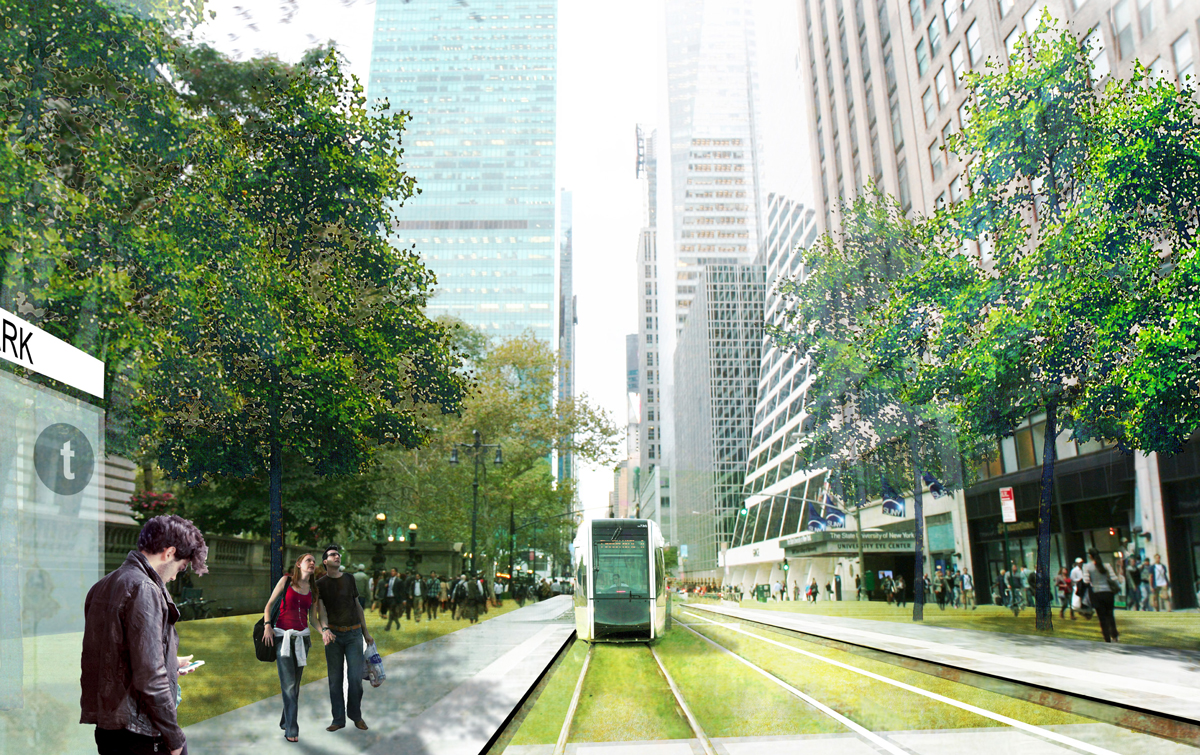
These two rail proposals for Midtown serve very different functions and are complementary. The subway provides speedy, underground, long-distance service, while the light rail line extends the reach of the subways to the rivers, providing a fine-grained, high-quality transit and walking experience at street level to all of 42nd Street’s destinations, including massive new and planned development on the far west and far east areas of Midtown that are not directly served by the subways or commuter rail. Its easy boarding and frequent access points make it an ideal collector/distributor for the subways and ferries, while its placement in a pedestrian street enhances access to all the subways, including the #7. Shown in Map A below is the route of the #7 extension as it was originally proposed, passing deep under Eighth Avenue and stopping at Penn Station before turning west to a terminus at the Hudson Yards.

The yellow and orange circles in the maps below represent a 700-foot radius of immediate impact of each station.

Map A:   This earlier plan by the City for the #7 extension, contrasts the very different travel needs that are served by these proposals. Because of the steep grade on the #7 subway line as it descends to cross under the East River, an additional station cannot be added at First Avenue to serve the UN Headquarters or the massive new development planned for the Con Ed sites. The light rail extends access to both waterfronts, serving developments that are planned along both the East and Hudson Rivers— thereby meeting needs for improved crosstown transit in a comprehensive way.

Map A


Map A: Areas Immediately Served by Proposed Midtown Rail Lines - 42nd Street Light Rail and #7 Subway Extension (original scheme)

Maps B and C show the City’s current plans for the #7. No longer connecting with Penn Station, it will continue from its present Times Square terminus, along 41st Street, with a station at 10th Avenue, and then south to a new terminus under 33rd Street between 10th and 11th Avenues.  The station at 10th Avenue and 41st Street is being postponed for budgetary reasons.  The entire extension is part of a plan for major new development, dominantly commercial, but including residential, in the area surrounding the LIRR West Side rail yards.

Map B

Map C

 
Map B: Extension of the #7 Subway — Ultimate, Two-Station Plan
Map C: Extension of the #7 Subway — Interim, One-Station Plan

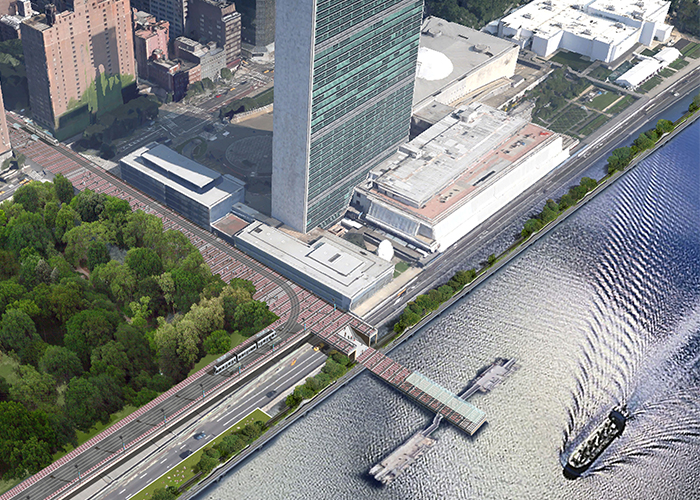
Maps D and E show the proposed alignment and station locations for the light rail transitway. On the west, the 42nd Street light rail line would turn south on 12th Avenue at 42nd Street and terminate at the new ferry terminal at 39th Street and 12th Avenue. On the east, it would turn south at the FDR Drive and terminate at the planned new ferry terminal at 35th Street.

But light rail is easily extendable. In a second phase, it could form a continuous two-way 42nd/34th Street loop —linking Penn Station with the Javits Center and Midtown Manhattan’s many tourist attractions. Efficient connections to ferries will help advance current waterfront projects along the riverfronts, not only in Manhattan, but in Queens and New Jersey.

Map D

 
Map E

 
Map D: vision42 Light Rail Plan — Initial Phase, plus a low-cost, high-capacity rail shuttle on existing LIRR tracks
Map E: Light Rail Phase 2 — The Midtown Loop — a two-way link among many important Midtown destinations and transit nodes.


vision42 needs your help to make our goals a reality.

Sign the Petition to Mayor Bloomberg
Contact Your Elected Officials
Donate to vision42

The Urban Land Institute, New York District Council, hosted a forum "Transportation Transformed: Innovations in the Tapestry of Urban Transit" on Tuesday, March 6, 2007, at 5 Times Square. Presentations were made on vision42, the High Line, the Water Taxi system, and THE (Trans-Hudson Express) Tunnel. Featured were key findings by vision42 consultants on the plan's construction costs and staging, its traffic impacts, and its projected economic and fiscal benefits of more than $1 billion annually — in large part the result of an expected increase of 35 percent more pedestrian traffic.

If you'd like to learn more about vision42, its traffic impacts, its costs, and its (tremendous) economic potential, we encourage you to familiarize yourself with the key findings of the vision42 Technical Studies, as well as the full reports - all available on this website.