
| |
Frequently Asked Questions
What happens to the traffic? (How is it possible for traffic to “shrink”?)
Traffic would be relocated to other crosstown streets, using the City’s prescribed methodology (see
Traffic Studies). Mitigation measures, such as changes in signal time, reallocation of street space, and
parking restrictions, can minimize the negative impacts of this relocation. In realty, however, much of
the traffic will not relocate. Experience has shown that—just as when a new road is opened to traffic, it
ends up generating more of the very traffic it was meant to accommodate—the reverse is also true.
This was demonstrated in New York, when two portions of the West Side Highway collapsed in
1973, forcing a change in travel patterns. Traffic counts were performed by the NY State DOT of all
motor vehicles crossing a 60th Street cordon, which showed that, while West Side Highway traffic
declined by 57 percent, only 7 percent of this traffic reappeared on other north/south streets in the corridor.
In the early 1950s, Robert Moses proposed the widening of Fifth Avenue as it passed through
Washington Square Park. Community groups strongly objected, and ultimately caused the complete
closing of the park to motor vehicles. Despite dire warnings by City officials, traffic volumes actually
declined on adjacent streets.
There is no established methodology in New York City for predicting this phenomenon; therefore,
traffic shrinkage is not included in the vision42 Traffic Studies. Traffic is nevertheless elastic, and people are
rational beings. If a street is withdrawn from use by motorists, they will either find another route to their
destination, or choose another mode to reach it. Particularly if a high-quality transit option is provided,
they are likely to take it.
What about the delivery of goods?
The delivery of goods has been carefully analyzed in the Traffic Studies. Most of 42nd Street’s large office
buildings have their freight entrances on either 41st or 43rd Street, since ground floor real estate on 42nd
Street is too valuable for this function. As also shown in the Traffic Studies, delivery bays would be
reserved at the intersections with avenues for stores that have no entrances on 41st Street, on 43rd
Street, or on an avenue. The added costs for around-the-corner deliveries is only a small fraction of the significant economic gains that are projected to result from an enhanced walking environment and high-quality surface transit.
What about taxi, limousine, and parking garage access?
Passengers of taxis and limousines can be dropped off/picked up at the entrances of the street’s large
office buildings on the avenues, 41st and 43rd Streets, where these exist. Others can enjoy a more
pleasant walking experience from the avenues along an auto-free 42nd Street.
There are four parking garages that are currently accessed only from 42nd Street. Several can
be served by reconfiguring adjacent streets. The largest parking facility accessible only from 42nd Street
is the Manhattan Plaza garage. Dyer Avenue can be converted into an exclusive two-way access drive
for this garage, and the traffic light at its intersection with 42nd Street retained. The other parking
garages and lots are on soft sites which stand to be redeveloped.
How long will it take to get across town by light rail?
The low floors of the light rail vehicles will allow speedy boarding/deboarding —only some 20 seconds at
each stop. Therefore, even with 16 pairs of stops along 42nd Street and the rivers, the river-to-river trip
will take roughly one half of the time of today’s crosstown trip —or no more than 21 minutes. This will be
a boon to travelers by ferry and other transit modes. The vision42 system is designed for vehicle arrivals
at 3.5-minute intervals at rush hours, and no less than 4-minute intervals all day long (see Cost Estimate Study). The dedicated right-of-way will allow these regular
intervals to be maintained, with no more bunching of transit vehicles.
What about pedestrian safety relative to light rail vehicles and bicycles?
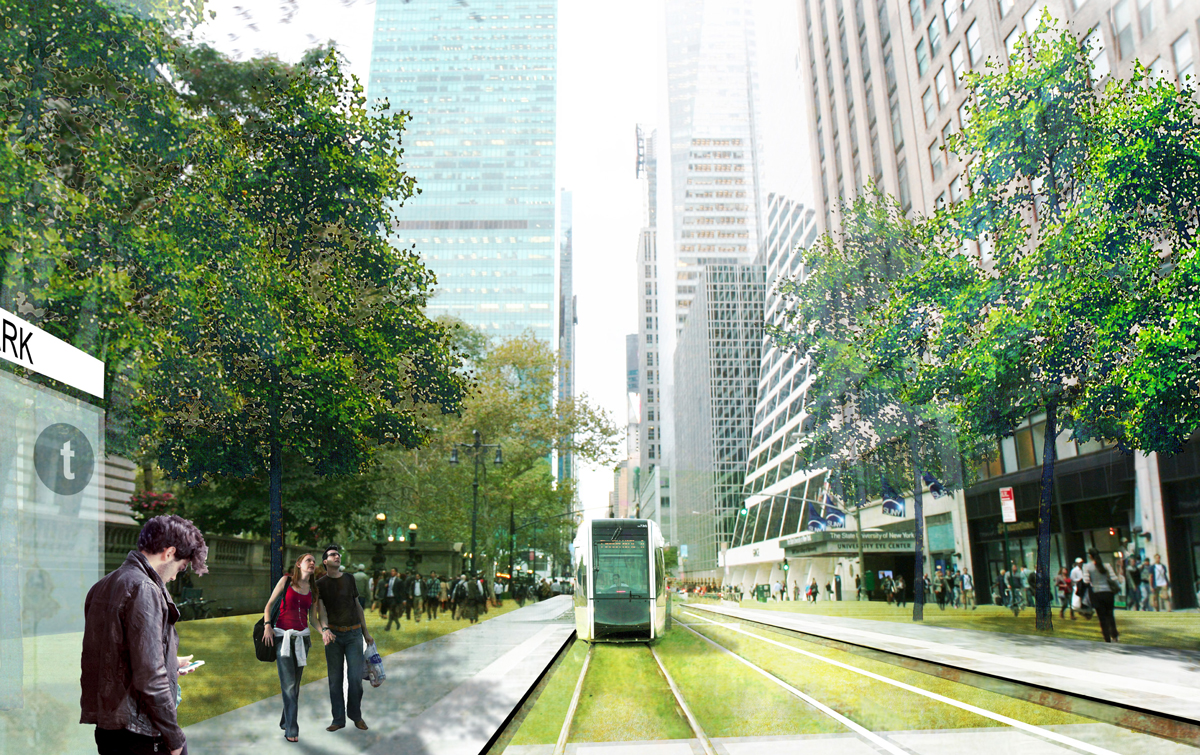
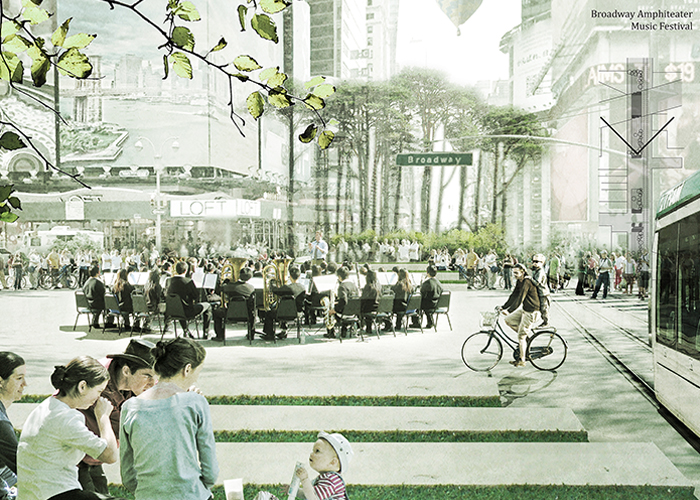
Pedestrians will have twice as much space as they currently do, and will not have to risk walking out into
the stream of traffic, as they often do today on the most crowded blocks. They will also have far fewer
vehicles to contend with —some 40 light rail vehicles per hour, compared with 1600 automobiles, buses
and trucks. The light rail vehicles will also be limited to 15 mph, and driven by professional transit
operators, who are well-schooled in rules of safety.
Pedestrians will cross 42nd Street and the avenues much as they do today. However, because
motor vehicles will not be turning into 42nd Street, crossings will be much safer for pedestrians, and
north/south traffic on the avenues will flow somewhat more freely. The traffic signaling will be
maintained as it is, unless the City DOT chooses at some future date to prioritize it for the light rail vehicles
(light rail trip time calculations have not assumed such prioritization).
During busy hours in the most crowded parts of the street, bicyclists will be expected to walk
their bikes, so that they don’t pose a threat to pedestrians. Just as on the subways in New York, farepaying
cyclists will be allowed to bring their bikes onboard the light rail vehicles, to the extent that there
is adequate space for them.
How long are the light rail vehicles?
The vehicle lengths are limited by the length of the shortest crosstown block to about 180 feet. Vehicles
will be articulated (have joints between components) and hold up to some 300 people.
We already have the Shuttle and #7 subway line. Do we really need another crosstown rail line?
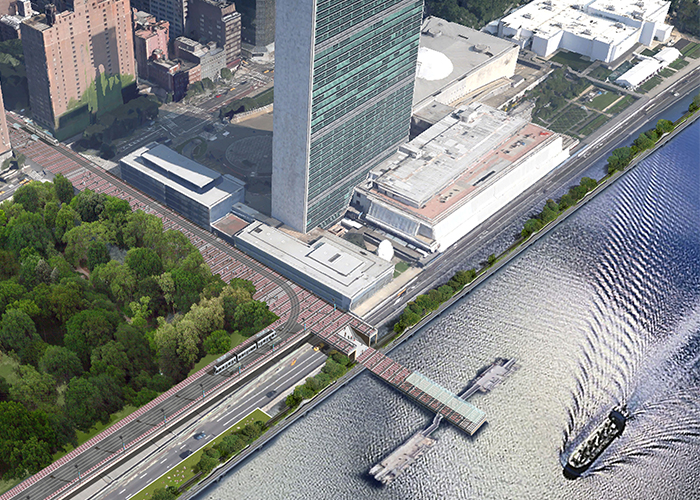
The light rail line will be a different type of service, reaching waterfront development and ferry terminals,
which neither the Shuttle nor subway can do. The Shuttle will remain useful for connection between the
7th Avenue and Lexington Avenue subways, but the light rail will have a much farther range. As a
surface transit system, it is also more convenient for local trips; whereas the #7 subway is 80 feet below
grade, requiring a lot of stair climbing.
What are the economic benefits?
The most significant economic benefits of vision42 projected by the Economic Studies are a 35% increase in annual sales at retail shops and restaurants on 42nd Street, and a one-time gain of $3.5 billion in commercial proerty values, which will translate into an annual $277 million in increased City and State property taxes —sufficient to finance construction of the project in less than two years. Experiences abound of similar circumstances in other cities. Research
suggests that, for every $10 million in capital investment, transit projects spur some $30 million in sales for
local businesses. Nationwide in 1987, 54% of businesses surveyed saw increased sales due to their
proximity to light rail transit, while more recently in Dallas in areas served by light rail, sales jumped 32.6%
above the city average. In Denver, throughout its ten years of operation, the light rail system has
supported a 5% yearly increase in the volume and prices of retail goods sold near stations, together with
a 5% increase in the value of retail properties.
How will vision42 be financed?
As detailed in the vision42 Cost Study, the 2.5-mile light rail line, with 16 pairs of stops, will cost between
$360 and $510 million in 2004 dollars to construct, depending upon the extent of utility relocations and
the choice of propulsion system. The costs, even assuming the higher estimate, can be financed out of
the increases in City and State tax revenues that will be generated by increased property values. This is
all money that would not be generated if the light rail line were not built, so it is not depriving any of
New York City’s other transportation needs, services, or social programs. And after the first two years,
vision42 will actually be generating substantial income.
Why not use buses, which are cheaper and avoid utility relocations?
The lower costs of the bus option have gained it popularity among transit planners, and low-floor, clean
fuel buses may indeed provide a good interim solution. However, buses lack light rail’s “pizzaz” for
attracting discretionary riders, its passenger comfort when fully loaded, and in particular, its
permanence for guiding development. The significant gains in commercial real estate values projected
in the vision42 economic studies, which in turn will generate sufficient tax increases to pay for the system,
are totally dependent upon the rail option—as a permanent transit investment.
Modern, low-floor light rail will be much faster than today’s buses—both because its exclusive
right-of-way will be easier to enforce, and because its low floors and multiple doors will allow speedier
boarding. Low-floor buses have been designed, but their wheels require that much of the floor space
be consumed by enormous wheel wells. Smaller-wheeled buses have also been designed, but they
require an extremely smooth pavement, which is difficult to maintain in a tough urban environment.
Light rail also carries three times as many passengers, which is important in a high-density city like
New York, and its smooth ride means that even standees travel in comfort, as witnessed by its strong
appeal to tourists.
How long will construction take, and how disruptive will it be?
Once the Mayor has indicated his/her support, two years should be allotted for the Environmental
Impact study and its approval, after which construction can be completed in two years, with minimum utility replacement, three years with full replacement (see Construction Phasing Study). Each block would be under construction for six months. The
diversion of traffic from 42nd Street should occur from day one, which will help to speed construction,
and a temporary low-floor, clean fuel bus service provided along 42nd Street to make the process as
painless as possible. The construction should be made as transparent as is feasible, so that the public
can observe progress as it proceeds, converting what would otherwise be a negative experience into
one of considerable interest and curiosity. Signs could be installed at the construction site that explain
to the public each step in the process.
|
|